
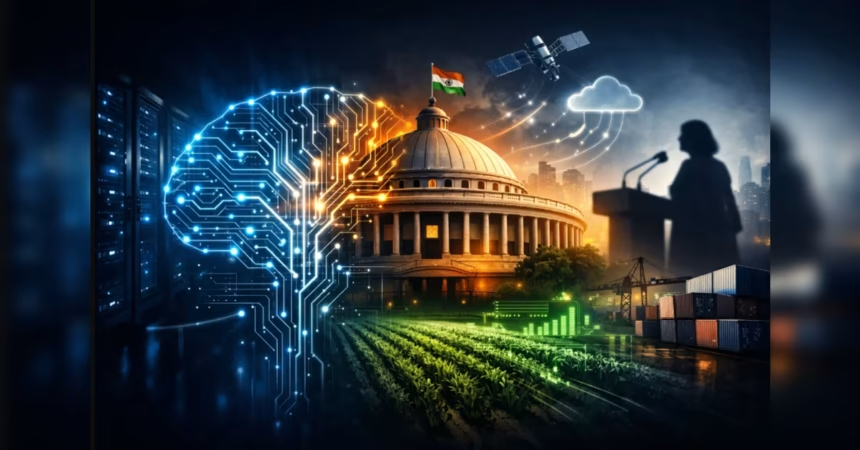
The Maharashtra Cabinet, chaired by Chief Minister Devendra Fadnavis, has approved the Maharashtra Artificial Intelligence (AI) Policy-2026. The policy aims to attract over ₹10,000 crore in investment and generate more than 1.5 lakh jobs by 2031.
Electronics, IT and AI Minister Ashish Shelar stated that the primary objective of the policy is large-scale employment generation. The policy will be implemented on the lines of the central government’s ‘India AI Mission’.
AI Infrastructure and Governance
A key mandate of the policy requires every state government department to roll out and implement at least one AI project. This directive aims to speed up administration, sharpen service delivery, and improve grievance redressal systems.
To build robust computing infrastructure, the state plans to provide at least 2,000 Graphics Processing Units (GPUs) under a ‘Compute-as-a-Service’ model accessible to all government departments. The policy also proposes the development of five ‘AI Innovation Cities’ and six sectoral Centres of Excellence in healthcare, agriculture, education, urban development, Marathi language and culture, and finance and revenue.
A permanent framework for ethical AI use is a core pillar of the policy, and it will be mandatory for every government department to undergo an annual ‘AI readiness audit’.
Skilling, Startups, and Industry Support
The policy targets training two lakh youth and professionals in AI skills through the proposed Maharashtra AI Mission. To strengthen the startup ecosystem, the government will set up a ₹500 crore AI Startup Venture Fund, with equal contributions from the state and private sector. Each startup is eligible for up to ₹1 crore in grant support, while women-led startups are entitled to up to ₹2.5 crore and an additional 25 percent financial assistance.
For Micro, Small, and Medium Enterprises (MSMEs), the policy provides a 20 per cent subsidy on AI adoption costs for 5,000 businesses and establishes a central ‘Maha AI Tools Hub’ platform. Industries will be offered incentives including a capital subsidy of up to 20 per cent, 100 per cent stamp duty exemption, and a power tariff subsidy of ₹2 per unit for up to 10 years.
Recent Implementation
In June 2026, the state rolled out ‘Maha AI – Maharashtra Hub for Advanced Artificial Intelligence,’ a platform developed by the National Informatics Centre (NIC) to integrate AI into routine administrative functions such as drafting official correspondence, file summarisation, and translation.
In August 2026, the government approved an ₹11.26 crore package to deploy sovereign AI solutions from Sarvam AI for government departments, covering a workspace for 2,500 users, speech models, and citizen outreach agents. The package includes a pilot of the Samvaad AI agent for tuberculosis awareness, making outreach calls to patients in local languages.