

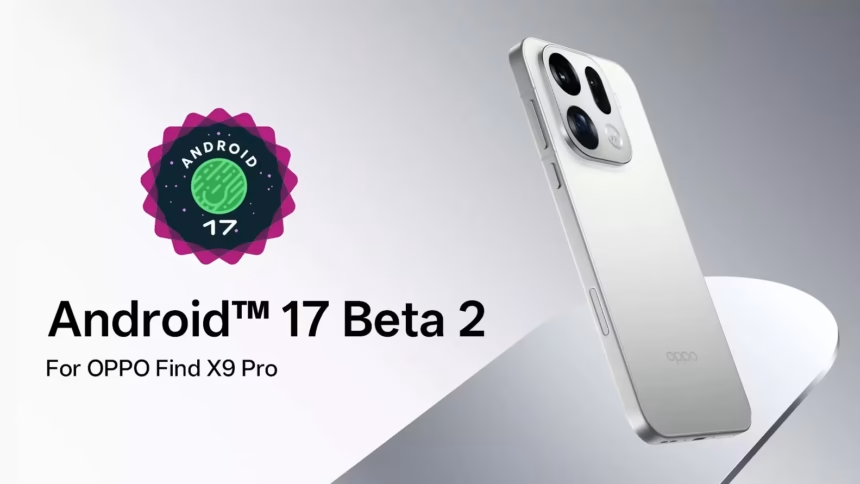
OPPO officially unveiled ColorOS 17 during its 2026 OPPO Developer Conference in Zhuhai on September 17, 2026. The new operating system is based on Android 17 and introduces a redesigned interface, performance engines, and expanded AI features across OPPO, OnePlus, and realme devices.
The update brings a new visual language OPPO calls Fluid Design. It features smoother animations, responsive touch effects, and visual transitions across the system. Interface elements can stretch or compress in response to touch, while translucent effects and lighting changes provide additional visual feedback.
ColorOS 17 retains a Liquid Glass-inspired aesthetic. The Control Center has been redesigned with circular quick-setting toggles and expanded volume and brightness sliders for one-handed adjustment.

OPPO also introduced interactive floating island navigation that runs across system utilities and core applications. These provide real-time status banners that expand and retract dynamically.
At the core of the performance improvements is the new Polar Light Engine. OPPO says it improves performance by cutting app startup time and memory usage by about 25 percent, while reducing rendering workload by 30 percent.
A companion Tidal Engine learns usage patterns to keep background apps running more reliably. OPPO claims it improves app stability by roughly 55.6 percent.

System optimizations also deliver roughly 20 percent faster app cold-start times and an overall 35 percent improvement in frame-rate fluidity during continuous scrolling.
The new On-Device Compute large language model uses a Linear Attention architecture. It natively supports 128K context, with OPPO claiming a 48 percent reduction in memory usage and 55 percent energy optimization compared to the previous generation.
OPPO upgraded its AI assistant with a dedicated space for managing tasks, a calls tool, and a memory feature that recalls saved information with one tap. The Xiaobu assistant gains features such as Xiaobu Space, memory functions, travel assistance, and one-touch notes.
The AI assistant can organize travel plans, surface relevant reminders, and handle certain tasks based on the user’s context. AI tools also extend to photography, with an AI Photo Editor supporting natural-language editing, while AI Notes can organize information from meetings, videos, books, and other sources.
The software adds new anti-fraud tools that can identify suspicious activity across calls, websites, and app installations. AI-based face-swapping detection is designed to flag potential risks during video calls.
ColorOS 17 also introduces a Persona X memory engine. It evolves from data perception, environment perception, and behavior perception, and introduces mechanisms for recording, forgetting, and reflection.
The Agent Matrix intelligent agent ecosystem framework upgrades the Xiaobu brain with longer context and stronger intent understanding. Under end-cloud collaborative optimization, Xiaobu’s beta satisfaction increased by 19 percent.
OPPO confirmed that ColorOS 17 will eventually reach more than 130 device models across the OPPO, OnePlus, and realme device families. The first devices to receive the update in China as early as October 2026 are the Find N6, Find X9 Series, OnePlus 15, OnePlus 15T, and realme GT8 Pro.
The second wave is scheduled for October 16 and includes the OPPO Find N5, Find X8 series, OPPO Pad 5 Pro, OnePlus 13 series, and realme GT 8 series. Further devices are listed for November or December.
The ColorOS 17 update will ship preinstalled on the upcoming OPPO Find X10 series and OnePlus 16. OPPO has not yet announced a confirmed India or global rollout timeline.