

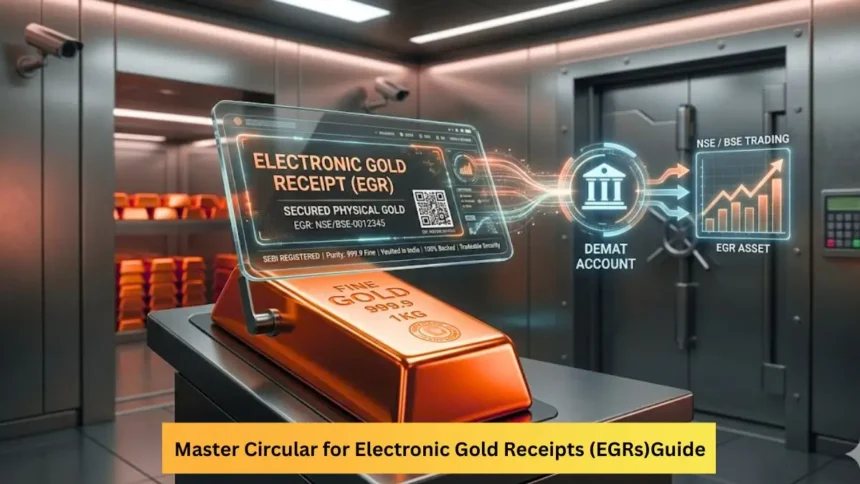
1. What is an Electronic Gold Receipt (EGR)?
Before exploring specific regulatory updates, it is important to understand the structural layout of modern asset classes.
An Electronic Gold Receipt (EGR) is an exchange-traded security that represents direct ownership of physical gold stored in secure, SEBI-approved vaults. Legally recognized as a “security” under Section $2(h)(iia)$ of the Securities Contracts (Regulation) Act, 1956 (SCRA), EGRs function exactly like equity shares. They are traded on recognized stock exchanges such as the National Stock Exchange (NSE) and Bombay Stock Exchange (BSE).
[Physical Gold Deposit] ➔ [Vault Manager Verification] ➔ [EGR Credited to Demat Account]
Key Operational Features of EGRs
- Purity Assurance: Every receipt is backed by physical gold meeting strict 995 or 999 fineness standards, verified by accredited domestic refineries or global imports.
- Perpetual Validity: Unlike traditional fixed-term instruments, an EGR does not expire. It can be held in a demat account indefinitely.
- Physical Conversion: Investors maintain the right to convert their electronic holdings back into physical gold through dedicated settlement windows.
2. Master Circular for Electronic Gold Receipts (EGRs)
To standardize operations across trading platforms, clearing corporations, and depositories, the Securities and Exchange Board of India (SEBI) maintains a updated compilation known as the master circular for electronic gold receipts egrs.

This comprehensive framework consolidates risk mitigation protocols, structural operational standards, and vaulting rules to ensure systemic transparency.
| Operational Dimension | Regulatory Specification |
| Primary Regulator | Securities and Exchange Board of India (SEBI) |
| Vault Supervision | SEBI-registered Vault Managers (e.g., Sequel, Brinks) |
| Settlement Cycle | $T+1$ rolling settlement cycle |
| Purity Benchmarks | LBMA Good Delivery / India Good Delivery Standards |
| Trading Window | Monday through Friday, 9:00 AM to 11:30 PM / 11:55 PM |
Risk Management Protocols
The master circular mandates a robust clearing mechanism to eliminate counterparty risk. Trading platforms must implement Value at Risk (VaR), Extreme Loss Margin (ELM), and Mark-to-Market (MTM) margin systems. This ensuring that vault operations remain perfectly balanced with active electronic trades.
3. Financial and Banking Master Circulars
Regulatory guidelines span multiple sectors, from gold-backed financing to systemic indirect tax management. Keeping track of these distinct circulars ensures legal compliance and operational fluidity.

Master Circular on Gold Loan
Issued primarily by the Reserve Bank of India (RBI), the master circular on gold loan governs how banks and Non-Banking Financial Companies (NBFCs) disburse loans against gold jewelry or ornaments.
The circular strictly defines the Loan-to-Value (LTV) ceiling, capping the maximum permissible loan amount relative to the market value of the pledged gold. It also specifies standardized valuation methods, transparent auction mechanisms for defaults, and stringent monitoring guidelines to safeguard financial sector stability.
Master Circular on Goods and Services
The master circular on goods and services serves as the definitive reference point for the Central Board of Indirect Taxes and Customs (CBIC) rules. This documentation outlines tax structures, point-of-supply determinations, and classification metrics for domestic commercial operations.
Master Circular for Export of Goods and Services
Cross-border commerce requires distinct compliance tracking. The master circular for export of goods and services establishes the legal framework for foreign exchange inflows, realization timeframes, and documentation under the Foreign Exchange Management Act (FEMA). It clarifies the use of bank guarantees, export declarations, and shipping bills required to process outward trade legally.
Master Circular for Refund Under GST
To alleviate cash-flow bottlenecks for businesses, the master circular for refund under gst compiles the standardized operating procedures for claiming excess Input Tax Credit (ITC) or taxes paid on zero-rated supplies. It limits subjective assessments by tax officers by detailing strict timelines, electronic application paths, and exhaustive documentation checklists.
4. Enterprise Data Systems and Code Standardizations
Modern enterprise resource planning relies on rigid, standardized codes to pass compliance checks and execute cross-departmental operations accurately.
E Invoice Master Code
Within digital tax networks, the e invoice master code registry forms the foundational schema for Generating Invoice Reference Numbers (IRN). These system codes standardize essential parameters:
- State Codes: Uniform two-digit identifiers for regional origin verification.
- Currency Protocols: Standardized acronyms to prevent cross-border computational errors.
- Supply Type Identifiers: Specific tags separating standard B2B trades, direct exports, and deemed export transactions.
Using precise master codes ensures that data transmitted between a company’s internal accounting software and national tax portals maps flawlessly, preventing system rejections.
How to Reverse a Receipt in SAP
Managing transactions occasionally requires adjustments for data entry errors or sudden order cancellations. When utilizing SAP ERP platforms, reversing a standard document receipt must follow precise logging trails rather than simple deletion.
1.Access the T-Code:Initialization.
Open the command bar and enter Transaction Code FB08 (for general ledger document reversals) or MIGO / MBST (if handling a material goods receipt reversal).
2.Identify the Target Document:Verification.
Input the specific Document Number, Company Code, and the relevant Fiscal Year. Ensure the data matches the erroneous entry precisely.
3.Select the Reversal Reason:Audit Compliance.
Choose a valid Reversal Reason code from the drop-down menu (e.g., 01 for a current period mistake, 02 for a closed period adjustment). This maintains a clear audit trail.
4.Post the Reversal Document:Finalization.
Execute and save the transaction. The system automatically creates a counter-balancing entry, netting the original receipt value to zero while preserving the document history.
5. Technical Artistry: Applying Gold Leaf to Delicate Mediums
Moving away from corporate registries and enterprise databases, specialized crafting techniques also follow exact step-by-step methodologies to achieve professional visual outcomes. Knowing how to gold leaf easter eggs requires shifting focus toward delicate material adhesion.
[Clean Surface] ➔ [Apply Adhesive Size] ➔ [Tackiness Window] ➔ [Leaf Placement] ➔ [Burnishing]
Necessary Crafting Materials
- Blown, hollowed, or wooden decorative eggs
- Water-based gold leaf adhesive (size)
- Loose or transfer composition gold leaf sheets
- Soft-bristle synthetic brushes and a specialized gilding mop
Application Technique
To achieve a smooth, mirror-like finish on curved eggshells, the adhesive must be applied in a thin, uniform layer.
Allow the adhesive size to sit until it transitions from a milky appearance to a completely transparent, tacky film. Applying the gold leaf while the adhesive is wet will drown the metal sheet, causing it to tear, flake, or turn dull over time.
Gently drape the leaf over the tacky shell surface, using a dry, soft mop brush to smooth out air bubbles from the center outward. Once fully cured, burnish the shell lightly with a soft microfiber cloth to remove excess flakes and reveal a clean, brilliant luster.
6. Sourcing and Institutional References
Maintaining compliance and executing precise operations relies entirely on using verified, official guidelines. For deeper exploration of the frameworks covered above, consult the direct primary resources listed below:
- Securities Market & EGRs: Refer to the comprehensive framework updates published on the Securities and Exchange Board of India (SEBI) Official Portal under the dedicated Master Circulars repository.
- Banking and Pledging Rules: For loan valuations, parameters, and credit limits, review the formal banking guidelines hosted on the Reserve Bank of India (RBI) Database.
- Taxation and Refunds: Direct procedural requirements for zero-rated processing, digital invoicing master schemas, and electronic tax filing structures are updated regularly on the Central Board of Indirect Taxes and Customs (CBIC) Portal.
Faq
What are Electronic Gold Receipts?
An Electronic Gold Receipt (EGR) is an exchange-traded, SEBI-regulated security that represents direct ownership of physical gold stored in secure, accredited vaults. Legally recognized as “securities” under the Securities Contracts (Regulation) Act, 1956, EGRs allow you to buy, hold, and sell gold digitally in your demat account without locker costs or purity worries. Each EGR is backed 100% by physical gold of standard 995 or 999 fineness, and you can convert your electronic holdings back into physical gold coins or bars anytime you want.
What is the SEBI circular for gold ETF?
SEBI’s core circulars establish that Gold Exchange-Traded Funds (ETFs) must invest directly in physical gold of 995/999 purity or in Electronic Gold Receipts (EGRs). In a major valuation update, SEBI shifted the Net Asset Value (NAV) pricing model for Gold ETFs. Instead of tracking international benchmarks like the London Bullion Market Association (LBMA) price, mutual fund houses must use polled domestic spot prices published by recognized Indian stock exchanges to make pricing more transparent and reflective of the actual domestic market.
What are the new rules of SEBI from 1 October?
SEBI implemented strict new rules for the Futures & Options (F&O) / Derivatives segment to manage market speculation and enhance structural transparency. Key updates include:
- Market-Wide Position Limits (MWPL): The limit for each stock is capped at the lower of 15% of the company’s free-float or 65 times its 3-month average daily cash delivery volume.
- Single-Stock Position Restrictions: Trading exposure limits are strictly capped—individual retail investors are limited to 10% of the MWPL per stock.
- Closer Monitoring: Stock exchanges now take multiple random intraday snapshots of trading exposures to strictly enforce risk margins and catch rule violations immediately.
Where can I buy EGR gold?
You can buy EGR gold directly online through your standard trading and demat account, exactly like buying equity shares. They are traded through a dedicated Gold Exchange segment on India’s primary stock exchanges, the National Stock Exchange (NSE) and the Bombay Stock Exchange (BSE). To buy them, you simply need to log into your account with a SEBI-registered broker (such as Zerodha or Angel One) that has activated the commodity or EGR segment, and search for symbols like GOLD999 or EGR during normal market hours.