

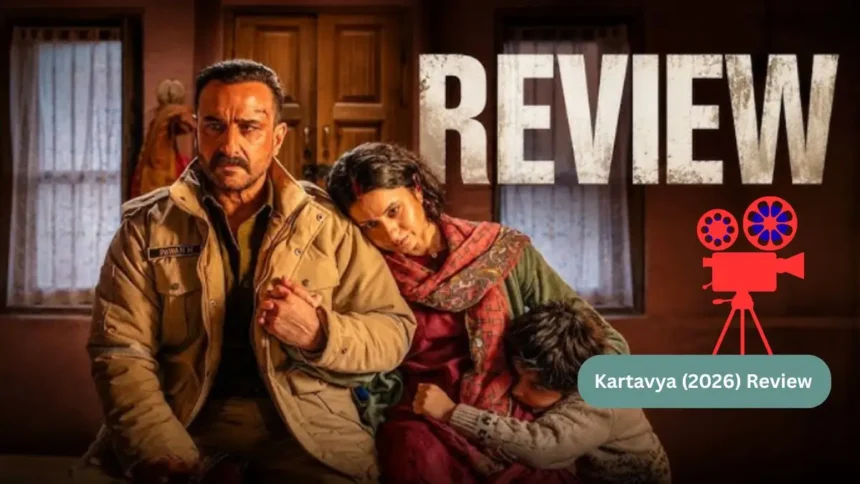
It was a rainy Friday night, and after a brutal workweek, all I wanted was to sink into my couch with a giant bowl of buttery popcorn and lose myself in a great thriller. I am a massive fan of raw, small-town Indian crime dramas—the ones filled with dusty lanes, complex morality, and heavy tension. When I opened Netflix and saw Kartavya (2026) sitting right on the homepage banner, featuring Saif Ali Khan looking weathered, rugged, and intensely focused in a police uniform, I thought I had struck gold.
I immediately hit play. As someone who watches hundreds of movies a year, I have a pretty sharp eye for when a film is going to be a masterpiece versus when it’s going to crash and burn. Over the course of its 108-minute runtime, Kartavya did a bit of both. It felt like a ride with plenty of ambition but a few flat tires along the way.
If you are trying to decide whether to invest your weekend downtime into this heavy Red Chillies Entertainment production, let me break it down for you straight. No marketing fluff, no generic synopsis—just my honest experience sitting through it, what worked, what missed the mark entirely, and how you can get the best experience out of it.

What Is the Buzz Around Kartavya All About?
Before jumping into the couch experience, it helps to understand why this movie had so much hype building up to its May 15, 2026 release. First off, it marks a major creative reunion. The film is produced by Gauri Khan under Red Chillies Entertainment, meaning it brings Saif Ali Khan and Shah Rukh Khan’s production house back together in the same creative ecosystem years after their legendary collaborations.
Furthermore, it’s directed by Pulkit, the creative mind who gave us Bhakshak, a film that handled extremely heavy social themes with incredible grit. Because Bhakshak was so grounded and impactful, everyone—including myself—expected Kartavya to be a knockout crime thriller.
On top of that, Saif Ali Khan returning to the gritty, small-town cop space on Netflix instantly triggered nostalgia for Sacred Games. We all wanted to see if his character, Inspector Pawan Malik, could capture that same flawed, captivating energy that made Sartaj Singh an absolute icon.

My Honest Review: A Tale of Two Different Movies
Sitting through Kartavya, I realized within the first twenty minutes that the film is constantly fighting a civil war with its own script. It tries to balance a high-stakes political assassination mystery with a deeply emotional, small-town family drama involving casteism and honor killings.
The Good: The Performances That Kept Me Glued
Let’s start with what actually worked, because when the movie is good, it’s genuinely gripping. Saif Ali Khan steps into the boots of Inspector Pawan Malik, a cop stationed in the fictional small town of Jhamli. Saif brings a tired, cynical swagger to the role. He speaks with a clipped, regional drawl that feels heavily inspired by raw crime shows like Paatal Lok. You can see the weight of the system pushing down on his shoulders, and his performance gives the film a much-needed anchor.
But for me, the real scene-stealers were the supporting cast:
- Yudhvir Ahlawat: He plays Harpal, a 16-year-old brainwashed shooter caught in a massive political conspiracy. His performance is astonishingly raw and vulnerable. You see a kid who has committed a horrific crime but is fundamentally just a terrified pawn in a game played by monsters.
- Sanjay Mishra: Playing a morally grey character named Ashok, Mishra effortlessly elevates every single scene he is in. He doesn’t need loud dialogues; his expressions tell you exactly how corrupt and dangerous the local landscape is.
- Rasika Dugal: Playing Pawan’s wife, Varsha, she performs beautifully with the limited screen time she is given, providing the emotional grounding the movie sorely needs.
The Bad: The Villain Problem and a Crumbling Screenplay
Here is where my viewing experience hit a massive speed bump. Every great crime thriller needs an absolute force of nature for a villain. Think of how terrifying the antagonists were in Sacred Games or Paatal Lok. Kartavya introduces a local spiritual guru and cult leader named Anand Shri, played by journalist-turned-actor Saurabh Dwivedi.
This, unfortunately, is where the movie loses its grip. The script spends a tremendous amount of time having other characters talk about how terrifying, untouchable, and menacing Anand Shri is. But when he is actually on screen? The menace completely evaporates.
Dwivedi’s dialogue delivery felt like he was reading a news script rather than playing a dangerous, manipulative cult leader. It felt stiff, overly formal, and completely broke the immersion of the gritty world Pulkit tried so hard to build. The internet has been brutally trolling his performance, comparing it unfavorably to daytime television, and honestly, sitting on my couch, I couldn’t help but cringe during a few of his major scenes. The character remains distant, unconvincing, and severely damages the stakes of the entire investigation.
The Plot Dilemma: Trying to Do Too Much
The movie kicks off with a brilliant, heart-pounding hook. Pawan is assigned to escort a visiting journalist who is digging into a massive child abuse racket tied to a local cult. Suddenly, bike-borne shooters ambush them. The journalist is shot dead right in front of Pawan. Desperate to save his career from public humiliation and a swift suspension, Pawan vows to hunt down the killers within seven days.
That setup is gold. It’s a classic, ticking-clock procedural.
However, the film unexpectedly shifts gears and throws a massive parallel plot line at you. Pawan’s younger brother, Deepak, elopes with a girl named Preeti from a different caste. This enrages the village panchayat and both of their traditionalist families, who promptly declare that the young couple must be hunted down for an honor killing. Pawan is suddenly forced to hide his brother and sister-in-law in a secret safehouse while simultaneously tracking down a runaway teenage assassin.
By trying to tackle the terrors of blind spiritual cults, political corruption, deep-seated caste anxieties, and the brutal reality of Khap Panchayats all in a 108-minute runtime, the movie ends up stretching itself far too thin. Just as you get invested in the high-stakes murder mystery, the film abruptly cuts to a domestic family dispute, breaking the pacing and leaving the final resolution feeling oddly rushed and emotionally hollow.
5 Common Mistakes to Avoid When Watching Kartavya
If you decide to stream Kartavya this weekend, learning from my experience can save you a bit of frustration. Keep these points in mind:
- Expecting Another Sacred Games: Do not go into this expecting a sprawling, multi-layered masterpiece with massive structural depth. It is a much tighter, lower-budget, straightforward crime drama.
- Watching it for High-Octane Action: This is a slow-burn, dialogue-heavy procedural. If you are looking for explosive gunfights or choreographed car chases, this isn’t the movie for you.
- Getting Hyped for the Villain: Lower your expectations for the main antagonist. Focus instead on Saif’s performance and the tragic story of the young boy, Harpal.
- Losing Track of the Parallel Timelines: The film cuts back and forth between the police procedural track and the honor-killing family track very rapidly. Pay close attention to the characters’ motivations, or the middle section will feel incredibly muddled.
- Expecting a Clean, Satisfying Ending: The ending arrives very abruptly. Prepare yourself for a conclusion that leaves a few thematic elements hanging in the air.
How to Set Up the Perfect Streaming Experience
Because Kartavya relies heavily on its dark, dusty, and atmospheric cinematography by Anil Mehta, watching it with the wrong settings can ruin the mood. Here is a quick step-by-step checklist I use to get the absolute most out of atmospheric Netflix thrillers:
- Kill the Ambient Light: This film uses a very muted, realistic color palette filled with night scenes and shadowy safehouses. Turn off your living room lights completely to avoid annoying screen glare.
- Check Your Netflix Streaming Quality: Ensure your streaming plan and internet speed are pushing high-definition or 4K playback. Compressed, blurry shadows will make the dusty landscape of Jhamli look like a blocky mess.
- Audio Matters: Turn on your soundbar or pop in a good pair of headphones. Anurag Saikia’s background score is beautifully subtle, and a lot of the tension relies on ambient small-town sounds—crickets, distant motorbikes, and whispered dialogues.
- Turn on Subtitles: Even if you speak Hindi fluently, the characters use heavy regional accents and specific small-town slang that can easily get lost if the audio balance isn’t perfect. Having subtitles on ensures you won’t miss key plot details during fast-talking interrogation scenes.
Final Thoughts: Is It Worth Your Time?
At the end of the day, Kartavya isn’t a bad movie; it’s just a deeply conflicted one. It is a perfectly watchable, brave, mass-targeted film that attempts to shine a bright light on very real, painful societal issues like caste violence and the manipulation of youth by powerful figures.
Saif Ali Khan delivers a commendable, gritty performance that proves he still commands the screen effortlessly in a khaki uniform. If you love grounded Indian crime dramas and have a couple of hours to spare on a quiet evening, it is absolutely worth a stream just to see Saif, Sanjay Mishra, and young Yudhvir Ahlawat do what they do best. Just be prepared for a bumpy screenplay and a villain that feels completely out of his depth.
For a look into the public reaction and a deeper breakdown of the casting decisions that shaped the film, you can check out this Kartavya Character and Performance Analysis. This video provides an insightful look into why the film’s antagonist received such heavy criticism from audiences online.