
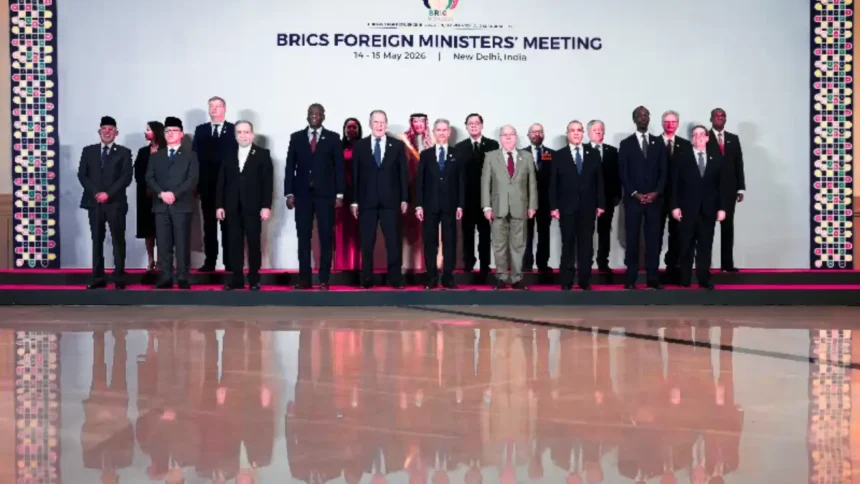
The BRICS foreign ministers meeting 2026 became one of the most important diplomatic events of the year as member countries gathered in New Delhi to discuss global governance, economic coordination, regional security, and the future direction of BRICS cooperation. The meeting attracted international attention not only because of the growing influence of BRICS, but also because the expanded group now includes countries with very different geopolitical priorities.
India hosted the BRICS foreign ministers meeting in May 2026 under its annual BRICS presidency. Foreign ministers and senior representatives from member nations participated in discussions focused on multilateral reform, trade partnerships, Global South cooperation, and international conflicts.
Unlike many AI generated summaries circulating online, understanding the BRICS foreign ministers meeting requires context. The 2026 meeting was not simply another diplomatic gathering. It reflected how BRICS is evolving into a broader geopolitical platform with increasing influence across Asia, Africa, the Middle East, and Latin America.
What Is the BRICS Foreign Ministers Meeting?
The BRICS foreign ministers meeting is a high level diplomatic gathering held before the annual BRICS Summit. Foreign ministers from member nations meet to discuss international developments and coordinate positions on major global issues.
The original BRICS grouping included:
- Brazil
- Russia
- India
- China
- South Africa
Over time, the bloc expanded and welcomed additional countries including:

- Egypt
- Ethiopia
- Iran
- United Arab Emirates
- Indonesia
Because of this expansion, recent BRICS foreign ministers meetings have become far more complex than earlier editions.
BRICS Foreign Ministers Meeting 2026
The BRICS foreign ministers meeting 2026 took place in New Delhi on May 14 and 15. India used the platform to promote stronger cooperation among developing nations and to push for reforms in international institutions.
External Affairs Minister S. Jaishankar stated that many global institutions continue to reflect outdated power structures and no longer represent current geopolitical realities.
The meeting covered several major international topics:
- Reform of the United Nations Security Council
- Economic cooperation among BRICS countries
- Global South representation
- Regional conflicts and security issues
- Trade and financial coordination
- Multilateral diplomacy
- Energy and food security
The discussions highlighted the growing ambition of BRICS nations to shape international policy beyond traditional Western dominated institutions.
BRICS Foreign Ministers List 2026
The following ministers and senior representatives participated in the BRICS foreign ministers meeting 2026 participants discussions:
| Country | Foreign Minister |
|---|---|
| Brazil | Mauro Vieira |
| Russia | Sergey Lavrov |
| India | S. Jaishankar |
| China | Wang Yi |
| South Africa | Ronald Lamola |
| Iran | Abbas Araghchi |
| Egypt | Badr Abdelatty |
| Ethiopia | Gedion Timothewos |
| UAE | Sheikh Abdullah bin Zayed Al Nahyan |
| Indonesia | Sugiono |
The expanded participants list demonstrated how BRICS has transformed from an economic grouping into a wider diplomatic coalition.
BRICS Foreign Ministers Names and Their Influence
Several leaders played especially important roles during the 2026 negotiations.
S. Jaishankar
India’s foreign minister focused heavily on institutional reform and stronger representation for emerging economies in global governance.
Wang Yi
China promoted deeper strategic coordination among BRICS nations while emphasizing trade cooperation and economic resilience.
Sergey Lavrov
Russia encouraged stronger non Western partnerships and expanded political coordination inside BRICS.
Mauro Vieira
Brazil continued advocating development cooperation, sustainability, and Global South economic priorities.
BRICS Foreign Ministers Meeting 2026 China Position
The BRICS foreign ministers meeting 2026 China discussions focused strongly on economic cooperation and geopolitical coordination.
China supported:
- Increased use of local currencies in trade
- Stronger BRICS financial institutions
- Expanded Global South partnerships
- Greater coordination among developing economies
Chinese Foreign Minister Wang Yi also emphasized the importance of maintaining stability during ongoing international tensions.
Why the 2026 Meeting Drew Global Attention
One of the most discussed outcomes from the BRICS foreign ministers meeting May sessions was the inability to release a joint declaration.
Differences reportedly emerged over:
- The Gaza conflict
- Regional security language
- Iran related references
- Diplomatic wording connected to Western powers
Instead of issuing a unified statement, India released a Chair’s Statement.
This development highlighted a growing challenge inside BRICS. As membership expands, reaching consensus on sensitive geopolitical matters becomes increasingly difficult.
BRICS Foreign Ministers Meeting 2025
The BRICS foreign ministers meeting 2025 took place in Rio de Janeiro during Brazil’s presidency.
Major discussion areas included:
- Economic partnerships
- Development financing
- Trade cooperation
- Currency settlement systems
- Institutional reforms
The 2025 meeting also reflected internal differences among member nations regarding trade policy and geopolitical alignment.
BRICS Foreign Ministers Meeting April 2025
The BRICS foreign ministers meeting April 2025 sessions helped prepare the agenda for the larger BRICS Summit later that year.
Topics discussed included:
- South South cooperation
- Trade protectionism
- Financial governance reforms
- Development bank coordination
Many of these discussions later influenced the policy direction seen during the 2026 meeting.
BRICS Foreign Ministers Meeting 2022
The BRICS foreign ministers meeting 2022 occurred during major global instability following the Russia Ukraine conflict.
Important discussion points included:
- Energy security
- Inflation pressures
- Food supply chain disruptions
- Post pandemic recovery
- Multipolar world order debates
The 2022 meeting helped strengthen coordination among BRICS countries during a difficult international period.
BRICS Foreign Ministers Meeting 2026 UPSC Relevance
The BRICS foreign ministers meeting 2026 UPSC topic is highly relevant for students preparing for current affairs and international relations.
Important points include:
- India chaired BRICS in 2026
- The meeting was hosted in New Delhi
- BRICS membership expanded beyond the original five countries
- No final joint declaration was issued
- Discussions focused heavily on global governance reform
This topic remains important for UPSC Prelims, Mains, and interview preparation.
Key Takeaways From the BRICS Foreign Ministers Meeting 2026
BRICS Expansion Is Changing Global Diplomacy
The addition of countries like Iran, UAE, Egypt, and Indonesia has significantly expanded BRICS influence.
Consensus Is Becoming More Difficult
The absence of a joint declaration revealed the diplomatic complexity of managing a larger and more diverse bloc.
India Focused on Multilateral Reform
India used the meeting to advocate reforms in global governance institutions and stronger Global South representation.
BRICS Continues to Grow as a Global South Platform
Despite disagreements, BRICS remains an increasingly influential voice for emerging economies.
References & resorces
- https://www.reuters.com/world/china/un-structure-reflects-an-earlier-era-india-tells-brics-meeting-2026-05-15/
- https://apnews.com/article/c2239256c5f08ad15739fb528a53aedd
- https://www.mea.gov.in/
- https://www.brics2026.gov.in/
- https://www.aljazeera.com/news/2026/5/15/brics-talks-end-without-joint-statement-as-divisions-over-iran-war-deepen
- https://theprint.in/diplomacy/india-fails-to-achieve-consensus-at-brics-foreign-ministers-meet-as-iran-dissents-on-palestine-red-sea/2932454/
How This Article Was Created
This article was prepared using verified reports from international news agencies, official government releases, and BRICS related policy coverage. Information was cross checked to ensure factual accuracy, updated geopolitical context, and relevance for readers researching BRICS foreign ministers meetings, participant lists, and current affairs topics.
FAQs
Who are the 11 members of BRICS?
As of 2026, the 11 BRICS members are Brazil, Russia, India, China, South Africa, Egypt, Ethiopia, Iran, United Arab Emirates, Indonesia, and Saudi Arabia.
Who are the 6 new members of BRICS?
The six new countries invited to join BRICS were Egypt, Ethiopia, Iran, Saudi Arabia, United Arab Emirates, and Argentina. However, Argentina later declined membership, while Indonesia joined BRICS afterward.
Who is the current head of BRICS?
BRICS does not have a permanent president or head. The leadership rotates annually among member countries. In 2026, India holds the BRICS chairmanship.
Who is the 10th member of BRICS?
The 10th member of BRICS is the United Arab Emirates (UAE), which officially joined the expanded BRICS grouping in 2024.
Conclusion
The BRICS foreign ministers meeting 2026 reflected both the opportunities and challenges facing the expanded BRICS alliance. While member nations continue working toward stronger cooperation, internal geopolitical differences are becoming more visible.
Still, the meeting confirmed that BRICS is evolving into a major diplomatic platform with growing influence over global discussions related to trade, governance, development, and international security.
For researchers, UPSC aspirants, and readers following international affairs, the 2026 BRICS foreign ministers meeting remains an important example of how emerging economies are reshaping modern diplomacy.