

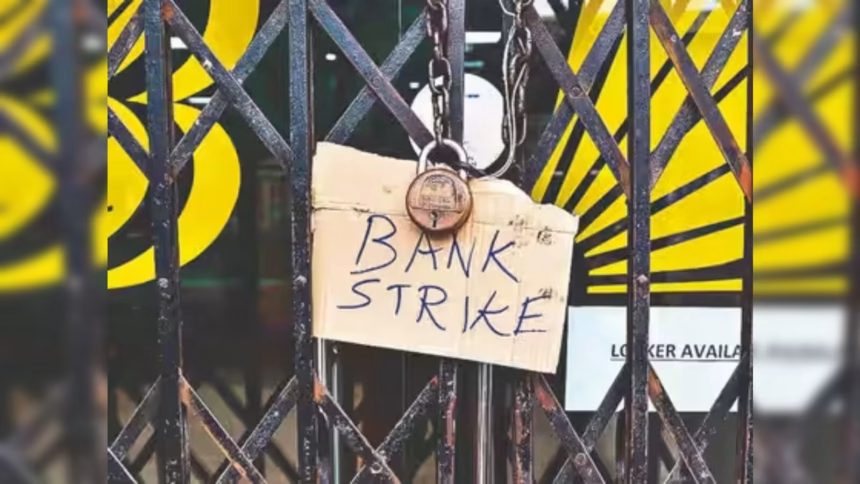
Bank unions across India will proceed with a three-day nationwide strike from September 28 to September 30, 2026, after conciliation talks with the government and bank management failed to resolve their primary demand for a five-day work week. To prevent a five-day banking shutdown, the central government has ordered all public sector banks and regional rural banks to remain open on Sunday, September 27, 2026.
The United Forum of Bank Unions (UFBU), an umbrella organization of seven employee and officer associations, announced the strike after a meeting on September 22 at the office of the Deputy Chief Labour Commissioner in New Delhi. The UFBU states it represents approximately 90 percent of the banking workforce.
The strike dates coincide with the half-yearly closing of bank accounts on September 30, a critical period for reconciliation, provisioning, and treasury operations. Because September 26 is the fourth Saturday of the month and September 27 is a Sunday, branch banking services face potential disruption for five consecutive days from September 26 to September 30.

Government Response and Sunday Operations
The Ministry of Finance issued a statement on September 23 confirming that the Reserve Bank of India has granted approval for all bank branches, offices, ATM-linked branches, and currency chests to remain fully operational on Sunday, September 27, 2026.
The ministry stated that the decision aims to ensure the genuine banking needs of the public are not adversely affected for an extended period. All Public Sector Banks and Regional Rural Banks will function normally on that Sunday.
The government and bank managements have appealed to the unions to defer the proposed strike. The Department of Financial Services convened a meeting with chief executives of public sector banks, regional rural banks, the Indian Banks’ Association, and Nabard to review contingency measures ahead of the strike.

Core Dispute: Five-Day Banking
The central dispute centers on the implementation of a five-day banking week. According to the UFBU, the Indian Banks’ Association agreed to the proposal in the 12th Bipartite Settlement and 9th Joint Note signed on March 8, 2024. The arrangement would extend daily working hours by 40 minutes from Monday to Friday in exchange for closing all Saturdays.
Rajesh Mehta, Secretary of the All India Bank Officers’ Confederation for Jammu, Kashmir, and Ladakh, stated at a protest demonstration that the proposal has been pending government approval for nearly two years. The UFBU noted that the Reserve Bank of India, Life Insurance Corporation, and General Insurance Corporation already operate on a five-day work week.
Government sources, however, stated that the Finance Ministry never committed to implementing the five-day work week. The proposal was forwarded to the government for consideration, but no assurance was given. This divergence in interpretation remains unresolved.
Additional Demands and Partial Resolution
Beyond the five-day week, the unions have raised demands regarding pension benefits and a performance-linked incentive scheme. The UFBU sought the withdrawal of a revised Performance Linked Incentive scheme for Scale IV officers and above, which the Department of Financial Services had directed banks to implement on August 21.
According to a UFBU statement, the Indian Banks’ Association informed the unions that the PLI scheme has been kept in abeyance as per government instructions and will be discussed further at the bipartite level. This addresses one of the two primary triggers for the strike.
The unions also seek the restoration of the Old Pension Scheme for employees covered under the National Pension System, a uniform dearness allowance formula for pensioners, and improved pension benefits. Government sources indicated that some movement has occurred on family pension increases and a pension option for employees who resigned from service.
Bank Advisories and Digital Services
Major public sector banks have issued advisories urging customers to complete branch-dependent transactions in advance. State Bank of India advised customers to use ATMs, internet banking, the YONO platform, mobile banking, and UPI for their banking needs during the strike period. Union Bank of India issued similar guidance, stating that branch operations could be affected on all three strike days.
Digital payment infrastructure is expected to remain largely operational. Unified Payments Interface transactions crossed a record 24.51 billion in August 2026, according to the National Payments Corporation of India, with an average daily volume of 790.6 million transactions. The government has also directed that September salaries and pensions for central government employees be disbursed by September 25 to mitigate the impact of the strike.
Union Clarification on Sunday Work
The UFBU issued a circular on September 23 addressing confusion among bank employees regarding whether they must report to work on Sunday, September 27. The circular noted that different banks were issuing varying instructions and that it was unclear whether September 27 had been declared a working day under the Negotiable Instruments Act.
The UFBU held an urgent online meeting on September 23 at 10:00 PM to discuss the matter. The forum stated it would gather full details of instructions issued by banks and take up the issue with the Indian Banks’ Association before advising members on attendance. As of September 24, the UFBU had not issued a final directive to its members regarding Sunday work.
The UFBU has also announced plans for an indefinite strike beginning October 26, 2026, if the five-day work week demand remains unresolved.